802-368-2591
|
|
802-368-2591 |
|
NewsTelecast Copperhead Supports Critical Analysis During World Series BroadcastsPosted by Jim Hurwitz
The dominating performance of San Francisco Giants starting pitcher Tim Lincecum in wrapping up the 2010 Major League Baseball World Series on Monday night was one of the best by a pitcher ever. And fans at home saw all 10 of his strikeouts in ultra slow motion, thanks to the X-MO camera coupled with the newest version of our Copperhead transceiver. Inertia Unlimited, a veteran production company in Jacksonville, Vermont that works with Fox Sports, has devised a new way to use the Copperhead 3400 fiber optic video transceiver —which was originally designed for 3-D production because it pairs two 1.5 Gbps-compatible Copperheads together—by mounting it on a specially modified Phantom HD high-speed camera, known as the X-MO slow-motion system. When used in tandem with the Copperhead 3400, the X-MO worked so well—converting baseband video signals to light in order to send the signals over 500 feet—that Inertia Unlimited president Jeff Silverman said he’s including it in all of his specialty camera systems going forward.
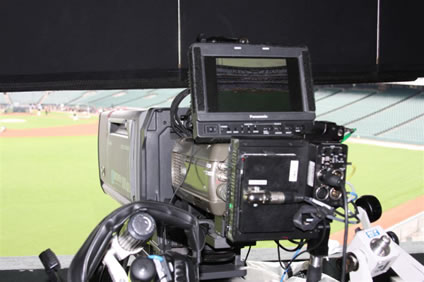
The X-MO system consists of a modified Vision Research Phantom HD high-speed camera with a Telecast Copperhead 3400 transceiver mounted on the back. “The slow-motion system that we use is capable of much higher frame rates than any other traditional slomo camera system,” Silverman said. “The system we used for the World Series was capable of running at 5,600 fps, so the quality is so much better. And because it worked so flawlessly, Telecast’s technology will be a staple of all of the systems we provide in the future.” The X-MO camera was located in a small compartment shooting over the center field wall and pointing directly at home plate (called the “tight center” angle) in both AT&T Park, in San Francisco—home of the new World Champion San Francisco Giants, and inside Rangers Stadium in Arlington, Texas. The unique point of view showed the ball slowly coming from the pitcher’s hand and into the catcher’s glove, allowing fans to see where the pitch landed. The effect was controlled with EVS SloMo playback controllers on board an NCP Productions HD truck in San Francisco and on board the Game Creek Video “Dynasty” truck on site in Texas. [These and other production companies provided feeds for Fox Sports domestic, an international feed for European broadcasters as well as a separate feed for Japanese audiences.] Silverman said the Copperhead is ideal because it reduces the amount of cabling required while providing the extra bandwidth needed to transmit two simultaneously 3 Gbps streams and a third 1.5 Gbps stream directly out of the extremely high-speed camera. This massive amount of data was stored in solid-state memory inside the camera and then sent back to the truck for playback via Ethernet connectivity. Providing the slow-motion feed and a regular (60 fps) HD feed back to the production trucks on site (where it was remotely controlled along with 30 other HD cameras) was critical to the live coverage and served as a great addition to the live HD broadcast for viewers. During the five games of this year’s World Series the X-MO system was used to shoot a live 720p HD stream, in addition to simultaneously recording two streams at 300 fps.
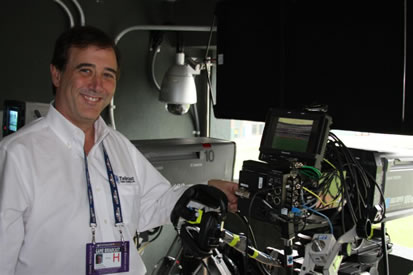
Here I am on site in San Francisco with a Copperhead 3400 on the X-MO system during 2010 World Series. The Copperhead 3400 has proven to be perfect for high-speed acquisition (using a camera originally designed for manufacturing applications) during live events. Leveraging the Vision Research camera, the resulting scenes are captured at speeds from 30 – 5.600 fps and then played back at 60 fps to create stunning super slow motion effects for enhanced viewer analysis. “We asked Telecast for a solution that would give us the data throughput we needed and the Copperhead 3400 is exactly what we were looking for,” Silverman said. “Telecast really came through for us.” Inertia Unlimited also used its X-MOS system during the American League Championship Series, complete with a Telecast Fiber Systems Copperhead 3400 transceiver. Tags: Fox, stadiums, CopperHead 3400, X-Mo
|
|||||||
| Goalie-Cam to deliver new perspective on hockey Jan 13, 2006 8:00 AM When the National Hockey League returns to NBC tomorrow, a tiny camera system mounted to the mask of the New York Rangers goalie will deliver a goaltender’s eye view of the game and give viewers an appreciation for just how fast hockey actually is. While it’s uncertain whether Henrik Lundgvist or Kevin Weekes will be tending the net, one of the two Rangers will don a goalie’s mask specially equipped with a tiny lens, camera and microwave transmitter that weighs just 6oz. Dubbed Goalie-Cam, the system is the creation of NHL Productions and Inertia Unlimited in Jacksonville, VT. It is one of several steps--along with the weekly presentation of a game in HD and a special commentator position between opposing benches called “Inside-the-Glass”--that NBC and the league are taking to pull viewers into the action. According NHL Productions coordinating producer Darryl Lepik, a duplicate mask of every goaltender was ordered from their manufacturers to support Goalie-Cam beyond tomorrow’s game. A small hole--about the size of a pencil--was drilled at the bottom of the duplicate masks. A lens assembly was inserted through the hole and connected to a small camera located where the back and the side of the helmet meets. A battery pack and small microwave transmitter are located on the portion of the mask covering the back part of the goalie’s head. A parabolic receive antenna will pick up the Goalie-Cam transmission and feed video to the teleproduction truck as camera position. Normally, the perspective TV viewers have of the puck is looking down on its 4in diameter face. With Goalie-Cam, they now will be able to see the puck coming in at them. Goalie-Cam will make its debut during NBC Sports production of Saturday’s game between the New York Rangers and Detroit Red Wings, the first regular season NBC has televised since April 1975. While the Rangers-Red Wings game will be produced in HD, Goalie-Cam is strictly an SD device that will be upconverted for the high-definition production. |
Inertia featured in TV Technology earlier this year
Click here to read the article
Close up action at NFL Cheerleader Playoffs
July 21, 2006
Springfield, Mass. – In scorching temperatures in the upper nineties, the 2006 NFL Cheerleader Playoffs provided some fierce competition. Inertia Unlimited provided close up POV action for fourteen events. Some of the events included kayak races and a swimming relay. These events were shot with waterproof Sony XC-555 POV systems including fixed mount and submersible pole camera. Teams also wore POV helmet systems for the tandem bike, roller skating, and skycoaster competitions. In addition to the 555’s Inertia provided remotely painted Panasonic AW-E650 and AW-E800As. The 11 weekly episodes of the 2006 Cheerleader Playoffs competition are scheduled to begin airing in October on NFL Network.
Inertia Unlimited Utilizes CF Based Solid State Recorder
July 23, 2006
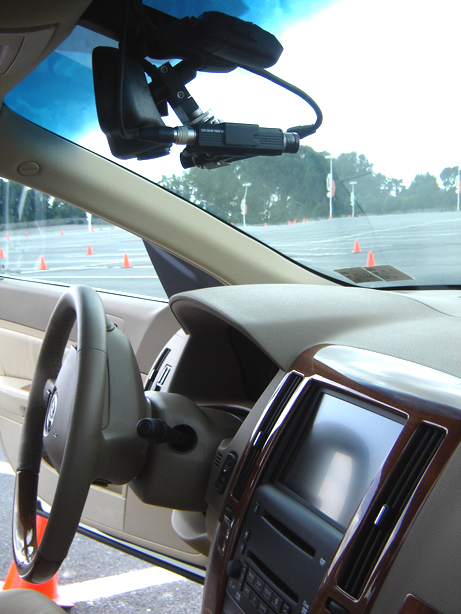
Washington, DC. – Inertia Unlimited has teamed up with ACME Branding Company to record participants for the Car and Driver Editor for the Day Tour. This fifteen city tour which started July 22 in Washington, DC at Fedex Field, consists of a comparison of the Cadillac STS-4, BMW 530xi, Cadillac SRX Crossover and the Lexus RX 350. To offer a new element to the experience, four sets of two Sony XC-555 cameras have been paired with Inertia Unlimited’s new dual CF solid state recorder. On board each car a picture in a picture effect is created capturing both a view out the front of the car as well as a shot of the driver. Videos are recorded as QuickTime files and there are absolutely no moving parts in the system making it immune to vibration and G-force. This recording process also helps shorten editing time immensely. Participants are able to download their test drive from Car and Driver’s website and share their experience with others. This type of in-car camera is a first for the ride and drive industry.
Poker Dome premiers at new location
Las Vegas, Nevada
August 8, 2006
Inertia Unlimited is one of the original innovators in the use of specialty cameras in broadcast poker. Inertia has raised the bar yet again with the Mansionpoker.net Poker Dome Challenge http://www.mansionpoker.net in downtown Las Vegas and is providing eighteen of the nearly 30 cameras. Poker Dome is the world's first custom designed poker arena that will accommodate an audience of 150 around a poker table enclosed in a glass dome. The audience gets to see all of the players cards as they are played and can see the players heart rate as well. To catch all the action Inertia utilizes Sony 8 HDCX310 HD robotic cameras on modified Stanton robotic bases, 7 Elmo UN43H’s, 2 Sony DXCC33’s and a Toshiba IKTU51. 9 of the cameras are iso-recorded on Sony DSR-45’s and the remainder on EVS recorders.
The show will run for 43 consecutive weeks for the next 3 years Sunday nights on FSN.